
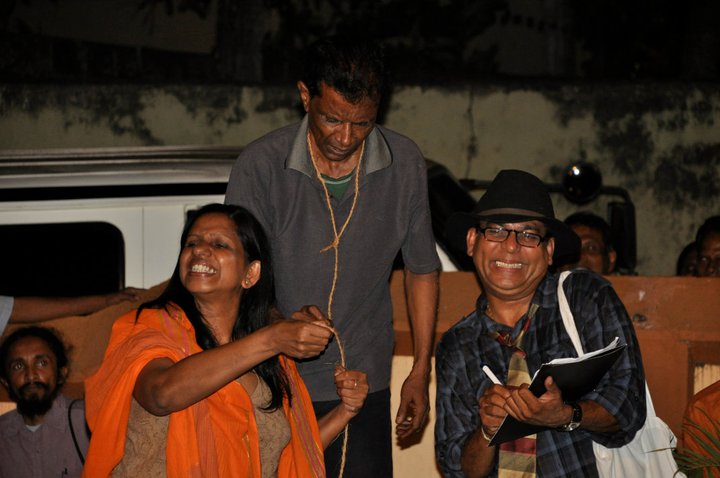
Taking to the Streets: Intersections of Space, Audience, and Power in the Wayside and Open Theatre
-By Kanchuka Dharmasiri
An unexpected event occurred in a population conference sponsored by the Food and Agriculture Organization of the United Nations in Sri Lanka in 1975. A new street theatre ensemble called The Wayside and Open Theatre had been engaged to entertain the international and local delegates as they sipped cocktails at the Foundation Center in Colombo, where the conference was held. Yet, their performance turned out to be anything but light entertainment. Arrayed in black tailcoats and demon masks, the company enacted a dark satire of the FAO’s World Food Conference which had been held in Rome the previous year.
The piece opened with actors representing western superpowers devouring food like animals and then gradually eating with more and more decorum but no less rapacious appetites. Then came the hungry delegate from Bangladesh, begging with his hat; he only got the discarded chicken bones and the leftovers from the wealthy nations. Meanwhile representatives of the powerful countries – still engrossed in their sumptuous meal – decided that the solution to the world food and population problem resided in a pill: a pill to be given to the developing nations. The performance ended with all the performers crying in unison in a rhythmic chant to the accompaniment of drums, “food for them, pills for us. Food for them, pills for us.” As the performance unfolded there was an uncomfortable realization on the part of the conference attendees that the performance they were witnessing was in fact about them. In his recollection of the event, Gamini Haththotuwegama, who led the Wayside and Open Theatre for more than three decades, characterized the audience reaction as one of silence, discomfort, and anger. The group had managed to break into the comfortable space of the powerful representatives of the organization and subvert it from within, calling the entire situation into question as well as highlighting its inherent performativity.
My intention in this article is to explore this sort of innovative use of space and audience on the part of The Wayside and Open Theatre. I will investigate how this group appropriates spaces and, through their performances, transforms them into transgressive sites where existing power structures are questioned and subverted. Using Ngugi wa Thiong’o and Safdar Hashmi’s contentions about space, performance, and power, I will examine how Haththotuwegama and his group use public spaces – by which I mean, train stations, bus stops, beaches – to address questions related to class, capitalism, economic liberalization, and neocolonial exploitation. I will analyze how their work contributes to the debates around space and power. What exactly occurs when performances are taken outside of the conventional enclosed proscenium theatre and brought out into the open? What is particularly powerful or threatening about such performances?
Ngugi wa Thiong’o, speaking of the conflict between the interests of the artist and the state in “Enactments of Power: The Politics of the Performance Space” (1997), affirms that “the nation-state sees the entire territory as its performance area; it organizes the space as a huge enclosure, with definite places of entrance and exit” (21). In such a configuration, the use of a bus stop or a train station for the purpose of a performance, rather than as a passive place to wait for the bus or the train, conflicts with the state’s conceptualization of the territory as its possession. The performer reconfigures the use of public space and thus could appear uncontainable within the regulations of the state. Safdar Hashmi speaks about this issue in detail, and he points out how “Groups of street theatre people are detained by the police almost every week in one part of the country or another” (4). He also goes onto show how this tendency of the police to arrest street theatre artists has escalated over the years. A factor that one should keep in mind here is that Ngugi and Hashmi are speaking from their practical experience in the field. Both artists faced state violence – Ngugi was imprisoned in 1977 and later more or less forced into exile; Hashmi was murdered in 1989 – as a result of their work which sought to create a critical and dialogic performance space for groups traditionally excluded from more mainstream theatre spaces. Haththotuwegama too has had his share of encounters with state authorities in his attempts to take theater to the streets.
To a certain degree, the desire to contain the use of outside spaces goes back to the colonial era, where any gathering outside was regarded with suspicion. In The Right to Perform, Hashmi contents that, “Since there is no law to prevent a dramatic performance in a public space, the police use antediluvian laws continuing from the British days” (4). In the pre-colonial era most of the performance spaces were open spaces and Ngugi asserts that one of the first steps taken by the British was to ban gatherings in public spaces. He examines how British colonizers violently repressed traditional performances that took place in open spaces in Kenya and points out the continuity of that repression on the part of local governments. The apparent fear of the brown or black body has taken a more classed nature in the present with the rise of the post-colonial nation state. The crowds that gather with the intent of an outside performance can be seen as a potential threat. In a discussion about Haththotuwegama’s, Hashmi’s or Ngugi’s work, a consideration of colonialism, post-colonialism, neo colonialism, nationalism, formation of a classed society, and the formation of a national theatre is necessary.
What had occurred in Sri Lanka with the establishment of the national theatre was a dislocation of theatre from the village into the cities, into well-structured buildings, mostly built by the British; in short, a move away from the circular performance space where people came and went as they pleased, where the spectator-audience interaction was different to the one that occurred in the proscenium theatre. Haththotuwegama thus asks in relation to the modern Sinhala theatre, “How “popular” has this new theatre been? How “national” i.e. in terms of its audience – reach?” (133). Since the creation of a national identity – by extension, a national theatre – becomes an activity of the bilingual elite classes, an entire segment of the population is excluded from this enterprise of nation-building.
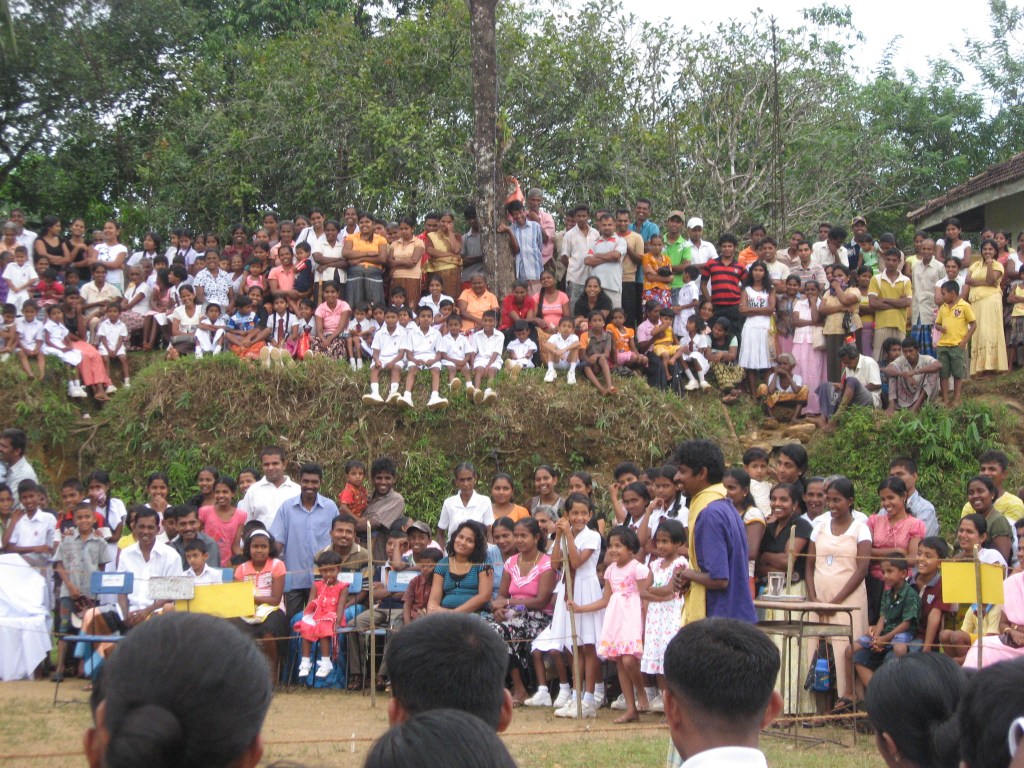
The Wayside and Open Theatre came into the scene at this specific juncture. The group formed together as an alternative, non-formal theatre in 1974. Moving away from the predominately middle class bourgeois proscenium theatres, they performed in the streets, factories, temple premises, universities, and in urban slum areas. In reaction to theatre having been an exclusive activity enjoyed by the middle classes, it was the group’s stated goal to cut through this specific dynamic and make theatre a part of the people. The group’s first performance was in a school playground in Anuradhapura where not many theatre groups tour. On their way back from the show, they also performed on the train station platform for passengers waiting for their trains. The concept of the audience changes drastically with a performance in a train station. It is almost a mobile audience.
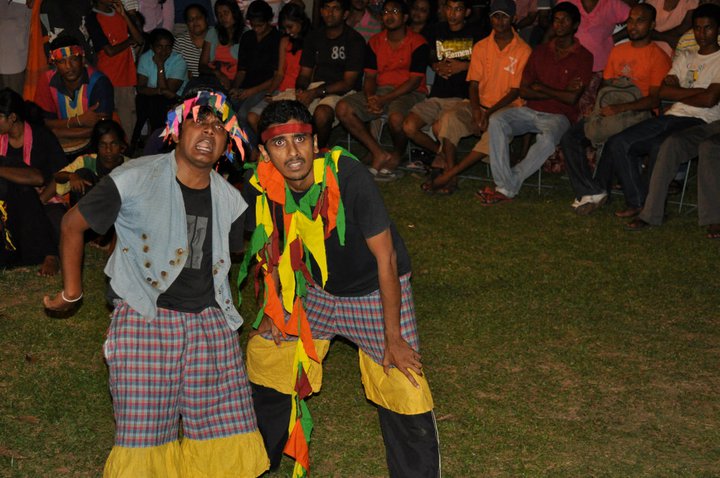
The Wayside and Open Theatre is particularly critical of the capitalist and consumerist ethos that has encroached into everyday living. Their short piece titled “The Open Economy” functions as a parody of compulsive commercialism. The piece was first performed in 1978, a time when Sri Lanka had started minimizing state control over economy, while promoting “free trade” and large scale foreign imports. Hence, their choice of the Galleface beach – a popular venue for merchants selling a variety of commercial goods – as the site to perform the short piece was significant. The group set themselves up on the beach and started selling the following items: machines to scratch one’s back, snow boots, and imported packaged air. They were in fact parodying the performative and absurd nature of consumer capitalism. The actors recall how during the performance, an undercover policeman tried to get into an argument and provoke them by asking why we need snow boots in a tropical country. The performance – a parody of consumer capitalism – created discomfort in the policeman. Why? Was the policeman angered and rendered uncomfortable by the presence of a crowd that kept gathering around the performers? Did he detect in the performers a specific threat that he did not find in the numerous other vendors who were on the beach? What in fact is the difference between the performing bodies and the vending bodies? Does one help establish the consumer capitalist status quo while the other disrupts it? Ngugi argues that “The war between art and the state is really a struggle between the power of performance in the arts and the performance of power by the state – in short, enactments of power” (12) This sort of a dynamic is apparent in the incident that occurred during the performance of “The Open Economy” because the police officer, a representative of the state, has the power to decide who is allowed to utilize public space and for what purpose. The group manages to point out through their performance and choice of words, the performative nature of consumerism, and this act poses a threat to the establishment.
The subversive dimension of the work of the Wayside and Open Theatre often results from the combination of the space in which their performance is enacted, and the language strategies they deploy in relation to that specific location. In Ngugi wa Thiong’o’s Drama and the Kamiriithu Popular Theater Experiment (2007), Gichiringiri Ndigirigi criticizes the tendency on the part of the critics to study alternative theater merely as a political form and to not pay attention to the intricacies and subversive dimensions of language usage, especially when it comes to studying works in local languages. I agree with Ndigirigi’s contention and perceive the strategies in language employed by Haththotuwegama and his group as a significant device used to approach various audiences. The song, “Dream world of Sri Lanka” captures the group’s ardent critique of consumerism and shows how “human, spiritual ideals and meanings are violently destroyed by materialist and commercial values” (Haththotuwegama, 155):
Everything O you can sell
Business going on very well
Country flowing milk and honey
We are rolling money money[1]
In Homi Bhabha’s terms, the group turns “the discursive conditions of dominance into the grounds of intervention” (35) at many levels: first of all, an altered local form of the colonizer’s language is used to comment on neocolonial power structures such as the exploitation of labor by multinational companies, tourism, and the child sex trade that has become a major concern. Likewise, an allusion is made to selling children for adoption. While the tourists come and go, “come and go” again a transformation of English to accommodate a popular idiom in Sinhala, figures such as Erik Solheim also come and go. Through the careful use of language and signs, Haththotuwegama and his group manage to show the connection between everyday life and global politics.
The signifier “the dream world of Sri Lanka” or “The loveliest flower of paradise” goes through multiple levels of signification and “an infinite number of sign-substitutions [come] into play” (Derrida, 197). These two lines taken directly from a travel brochure intersect with and make an ironic comment on the nationalist discourse that constructs the image of the country as a paradise. The vocabulary of tourism and nationalism is juxtaposed with consumerism and multinationalism. The reference to the land as a “peace zone” is blatantly contradicted by the civil war that has devastated the island for decades. The song thus is a commentary on the various power structures that intersect and have inscribed their mark on the postcolonial nation state. Thus, in the context of Haththotuwegama’s poem, tourism, consumerism, politics, and the child sex trade and the idea of paradise are intricately connected; an infinite number of meanings are created and “the domain or play of signification …has no limit” (Derrida, 198).
The significations of the word “sell” keep on differing/deferring as well: since we can sell everything, we are selling children to foreigners and the country to multinationals. Even the well-known Sinhala idiom of prosperity, flowing with milk and honey, which is traditionally associated with reaping a good harvest or being content, is used ironically in relation to the modern day idea of prosperity focusing on commerce. The ability to sell everything becomes the defacto condition that makes the country prosperous. The official nationalist dictum of the country extols the prosperity of Sri Lanka, but in the context of the song “Dream World of Sri Lanka” the signification of this prosperity keeps on differing.
To conclude the article, I would like to revert to the performance I mentioned in the beginning, the one that took place during the seminar organized by the World Food and Agriculture Organization of the United Nations. There, the audience was different. In a space that was neither the streets nor the well-structured theatre, the group performed for a crowd of local and international delegates affiliated with the population conference. This piece also illustrates implicit trajectories of colonial, neocolonial and local powers. In the interaction between the international organizations and “third world” nations, the “third world” nations often benefit the least. To use the group’s own metaphor, they have to eat the leftovers. By literally enacting this metaphorical interpretation of the international power structure, the performers shocked their audience and disrupted the performing space of the conference itself, turning active policy makers into a captive audience. With the audience’s comfort thus disturbed, and the power dynamic at least temporarily shifted, the performance opens up a space for discussion. It is, therefore, precisely because of the types of spaces in which they choose to perform that the group makes a significant impact on their audiences, operating a critical intervention that both questions and subverts colonial, neocolonial, class, and state power structures.
Works Cited
Bhabha, Homi. “Signs Taken for Wonders”. The Post-Colonial Studies Reader. Eds. Bill
Ashcroft, Gareth Griffiths, & Helen Tiffin. London: Routledge, 1995.
Derrida, Jacques. “Structure, Sign and Play in the Discourse of the Human Sciences”.
Modern Literary Theory. Eds. Philip Rice & Patricia Waugh. New York: Oxford University Press, 2001.
Hashmi, Safdar. The Right to Perform: Selected Writings of Safdar Hashmi. Delhi: SAHMAT, 1989.
Haththotuwegama, Gamini K. “Unresolved Contradictions, Paradoxical Discourses and Alternative Strategies in the Post-Colonial Sinhala Theatre”. Abhinaya. Battaramulla: Ministry of Cultural Affairs, 1998: 130-69.
Ndigirigi, Gichingiri. Ngugi Wa Thiong’o’s Drama and the Kamiriithu Popular Theatre Experience. Trenton, NJ: Africa World Press, 2007.
Ngugi Wa Thiong’o. “Enactments of Power: The Politics of Performance Space.” The Drama Review. 41.3. Cambridge: The MIT Press, 1997.
Endnotes
[1] Everything O you can sell
Business going on very well…
Country flowing milk and honey…
We are rolling in money money…
Lanka is a dream world…
The loveliest flower of paradise…
This is how sons of gods are born…
In this peaceful zone…
Tourist coming and
Tourist going
Solheim also come and go…
We are buying we are selling…
In our paradise zone…
Country flowing milk and honey…
Human wealth increasing greatly…
This is how sons of gods are born…
In this peaceful zone…
Buddha’s footprint up above…
Gods are watching
From the sky…
We will sell ourselves today…
And our flesh and blood
We are selling flesh, blood, or bones…
Or sacrificing daughters and sons…
In the market we are puppets made to dance…
Country is going to multinationals
Country is going to multinationals
 kanchukadharmasiri.info
Leave a comment